PRESERVING HISTORICAL HERITAGE
Tomás Alves
by Sara Belo Luís
translation Arisai Vogel
photograph Luísa Ferreira
“PRESERVATION IS ALSO IMPORTANT TO CHALLENGE THE IDEA THAT 'THINGS WERE BETTER IN THE OLD DAYS' ”
Once it is ready in 2027, the David Lab will make its documents and historical objects available. It is a project — the only one of its kind in the country — that brings together the social sciences and cutting-edge technology.
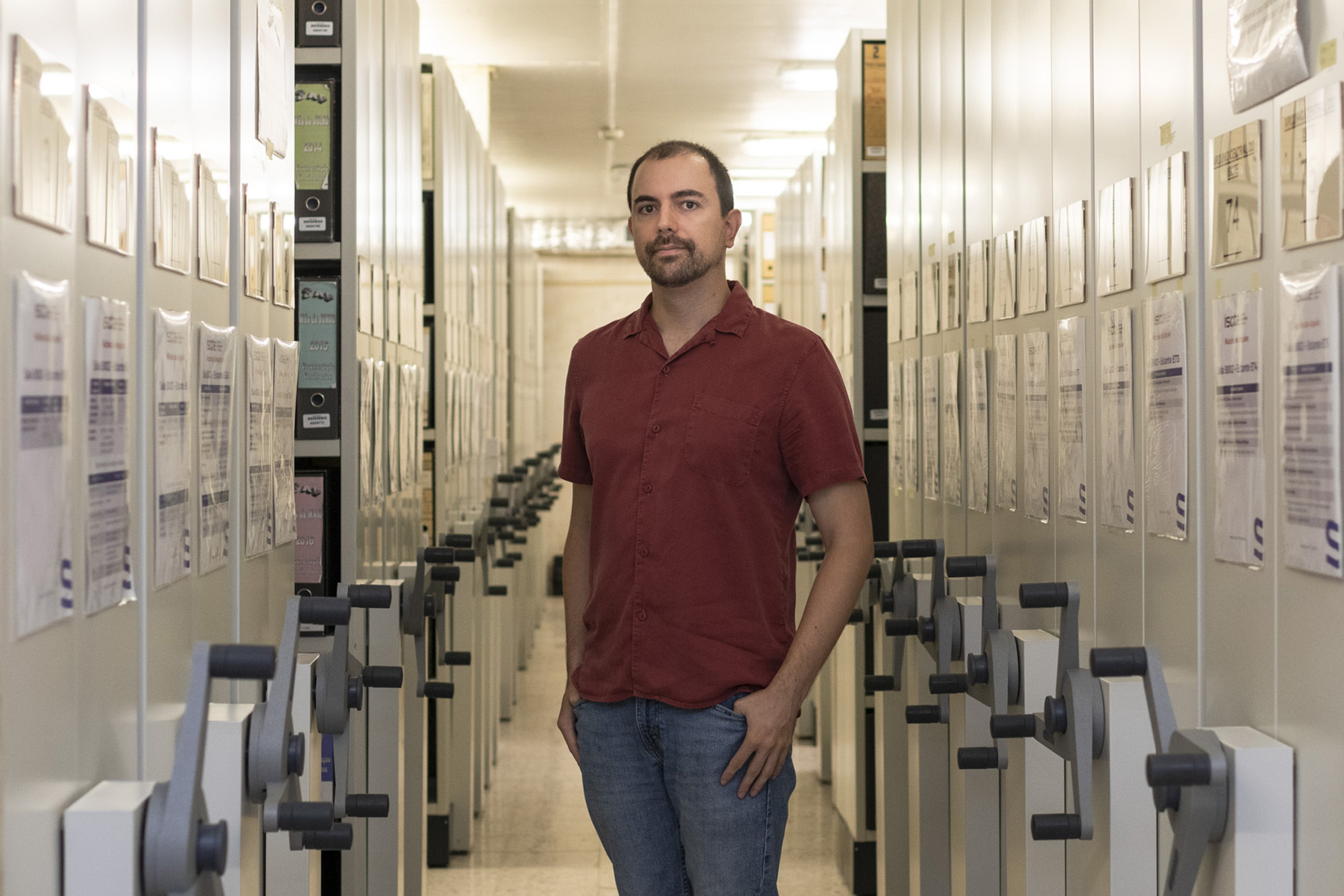
As a computer engineer, Tomás Alves makes no secret of how happy he is at Iscte. He has been working on various projects with scientists from other disciplines, particularly in the social sciences. He sees interdisciplinarity as an enriching way of doing science: “It helps us apply everything we’ve learnt at university.” At the Advanced Data Digitisation and Visualisation Laboratory (David Lab), it will help researchers better understand the past.
Once the project is finished, what will we be able to see and do at the David Lab, which is currently under construction?
The David Lab will be a facility with a streamlined production line for digitisation, data processing and visualisation. In a typical scenario, someone will come to us because they’d like to preserve a specific historical collection — a local council, for example…
Could it be a paper-based collection, or not necessarily?
It doesn’t matter — it could be in any format. One scenario we might encounter is an architect’s portfolio that needs digitising, which means we’ll be digitising 3D objects. These collections or archives should already be catalogued so we can assess what is worth preserving. For example, if there are many duplicate documents, it’s not worth taking up space.
So will these archives be physically stored here?
No, all the archives will be returned to their owners — we aren’t doing physical archiving here. What we’ll do is the entire digitisation process, including checking whether the materials we’re going to digitise are in the right condition. The digital preservation we provide will be hosted in our data centre, whilst always keeping our goal of democratising access for any researcher and society at large. Then, we’ll also have to think about how we’re going to design a sustainability model because you have the costs of all the people working here, electricity, air conditioning…
I’d like to interpret metaphors in posters from the Ephemera political archive, even when we lack the exact historical context. We’re already starting to see LLMs that use computer vision and can do much more than just read text.
Since it’s not a physical archive, is the storage space unlimited?
No, unfortunately it isn’t. Even though a lot of people think everything fits into memory once it’s digitised… In fact, one of the problems we face today is that many people assume, once something is digital, it no longer has maintenance costs — it exists somewhere, but it’s not my responsibility to maintain it… At the David Lab, we want to achieve sustainability by design — in other words, we want to provide open access whilst remaining responsible. We’re still working out exactly what that strategy will look like.
The second phase will therefore be the processing phase. What does this involve?
We will primarily be using data science techniques combined with applied artificial intelligence. Imagine this: a document is scanned using OCR — Optical Character Recognition — and we can then enrich the metadata. This enables more semantic searches, identifies groups connected over time and traces a timeline of events — at Sintra railway station, for example.
In the final phase — visualisation — what’s planned?
Our aim is to have two visualisation rooms: one more analytical, the other more immersive. We’ll have a huge, touch-sensitive video display measuring 4.8 by 2 metres, designed for a group experience. In there, it’ll also be possible to have augmented reality and virtual reality experiences, as well as scent synthesis and 3D sound production. We’ll even be able to have two people in the same room experiencing different sounds.
Could this be important for audio files, for example?
Yes — audio files, the preservation of folklore or traditional dances… In the other room, everything will be more based on data analytics — which is the traditional approach to data analysis — as well as experiences with tangible artefacts. For example, imagine you are looking at a globe showing human migrations on planet Earth as a result of some historical event. The projection — and here we can assume it’s augmented reality — will be displayed directly on the globe in front of you. If you want to interact with it, you’ll do so via an Internet of Things device — a sphere fitted with an accelerometer. By rotating the sphere, you’ll also be able to rotate the projection. Furthermore, we’ll have remote access via a portal where people can consult the metadata for everything — all the projects and all the collections.
Digital preservation will be hosted in our data centre, whilst keeping our goal of democratising access for all researchers and society at large.
Does that explain why this is a unique project? Is there nothing else like it?
No, there is no other infrastructure that has a pipeline like ours: digitisation, processing and visualisation. But this does not mean that all processes go through all three phases — through the entire life cycle. For example, we might already have the data and simply carry out the visualisation.
How did this project come about?
It’s interesting because David Lab came about when Iscte signed an agreement with the IMT (Institute for Mobility and Transport) to construct Building 4 on the site of the former IMT building. It was then agreed to digitise the IMT’s historical archive: diagrams of the mapped routes, as well as documents describing artefacts like drivers’ caps and hats. It’s a very extensive and fascinating collection — a historical archive that we’ll be working on.
Meanwhile, more archives and external partners have emerged.
Yes, we have partnerships with Lisbon City Council, the Portuguese National Committee of the International Council on Monuments and Sites (ICOMOS-PT) and the Ephemera archive. Recently, I told my project colleagues — Elsa Cardoso on visualisation, Alexandra Saraiva on digitisation and João Pedro Oliveira on processing — that I’d really like to interpret metaphors in Ephemera’s posters even when we lack the exact historical context. We’re already starting to see multimodal LLMs that use computer vision and can do much more than just read text — they can actually interpret visual artefacts.
It’s at the intersection of different research fields that Iscte truly comes into its own.
And that’s exactly what the David Lab is all about.
But a metaphor is, by its very nature, subjective and ambiguous…
Yes, but I imagine that with supervised Artificial Intelligence, we can establish patterns of interpretation. I think that with the help of archivists and historians, this could be very interesting — and it’ll help us gain a better understanding of what it was like to live in that environment at that time. Preservation is also important as a way of challenging the notion that “things were better in the old days”. If we take a closer look, we realise that, unfortunately, the past wasn’t actually all that great. What we can do next is have conversational agents specialising in the collections…
A chatbot I can have a conversation with, that makes my research easier?
Yes, an agent I can talk to and tell, for example, that I’d like to know more about The Carnation Revolution, its history and the organisations involved. All of this is quite interesting — it’s work that needs to be done, and it isn’t at all automatic. When a human reads a text, they can easily identify the various organisations. Semantics isn’t always straightforward, but it’s also possible for an agent to recognise that the same entity is being referred to by two different names, for example.
For you as an engineer, is this interdisciplinary approach challenging?
It’s challenging and, above all, very rewarding. I actually think that’s where you can really make the most of Iscte’s interdisciplinary approach. It’s in the overlap between different fields of research that Iscte really comes into its own. And that’s what the David Lab is all about.
What exactly do you gain from this interdisciplinary approach?
It really helps us to apply everything we’ve learnt at university. Since I arrived, for example, I’ve been working closely with Rita Guerra, who’s a social psychologist. We even have a project, starting next academic year, called “Morality”, which looks at disinformation and how perceptions of crimes linked to migrant communities are conveyed through data visualisations. You only have to look at the social media accounts of certain political parties to see disinformation being spread through infographics. For the average person without much visual literacy, it isn’t always easy to understand.
Could the David Lab be mistaken for a museum?
No, I don’t think it can even function as one. It will be a living laboratory, conducting experimental studies and developing digital heritage experiences. Initially, its role will be to support research — and then there’s the whole aspect of democratising knowledge so that people can learn. We just need to start creating experiences to attract people here, so that they come of their own accord.
Will it be open to schools?
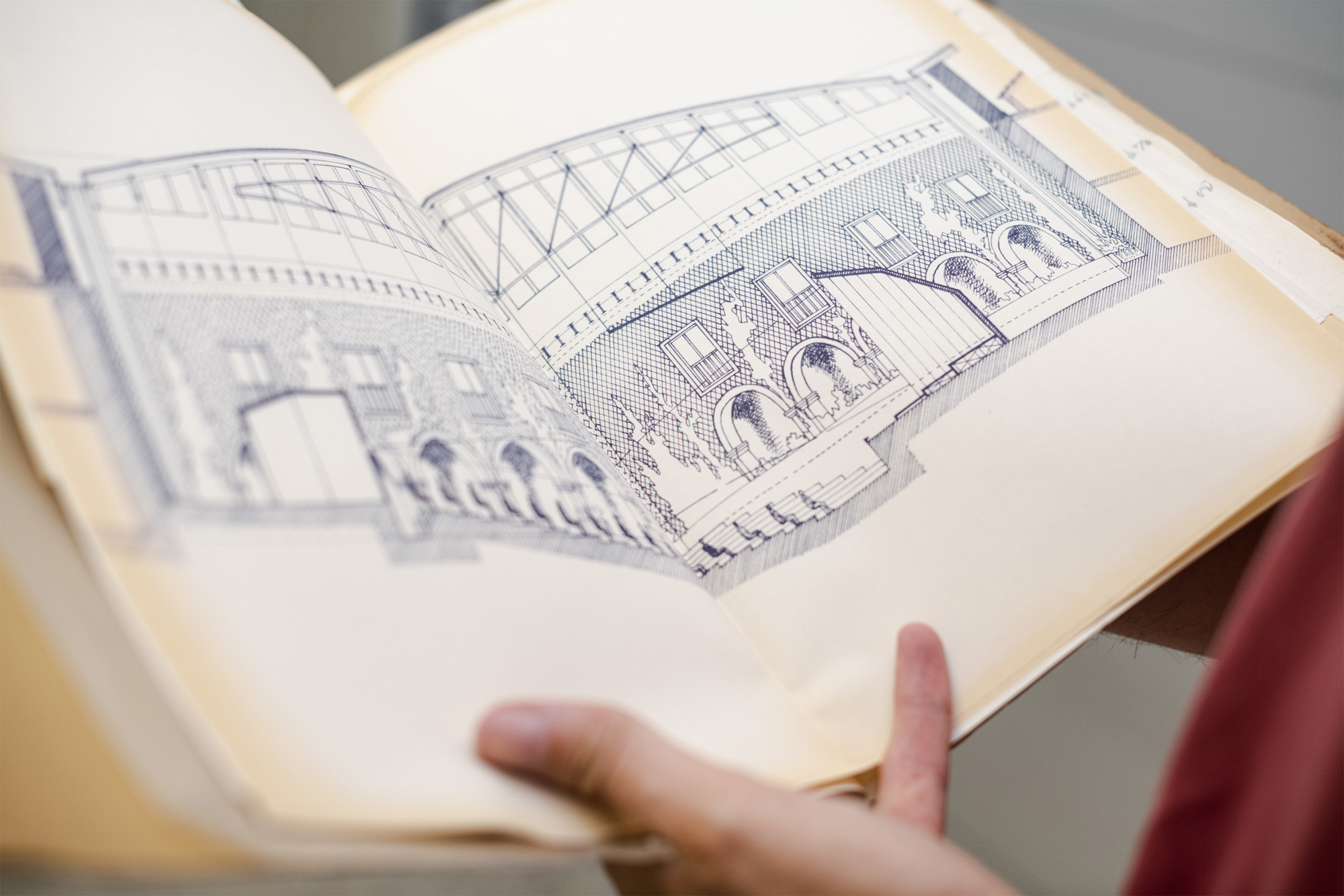
Yes — for architecture students, I think it would be extremely interesting to be in a virtual reality or augmented reality room, designing architecture in real time. In principle, one of the first showcase experiences we want to offer at the David Lab is to demonstrate what it would have been like if an architectural project that only ever existed on paper had actually been built. In the estate of the architect Luís Cunha, for example, there are many works that were never built. For an architecture student, when modelling a building, it could also be fascinating to know how sound will replicate through specific materials used for the walls, floors and doors. We can do this as soon as we have our 3D sound speaker array.
|
Tomás Alves BRU-Iscte |
David Lab Operating across three core pillars — archive digitization, big data processing, and interactive visualization — the David Lab will digitize historical archives to make them fully accessible to the general public. |