NEW 6G TECHNOLOGIES
Sérgio de Almeida Matos
by Sara Belo Luís
translation Arisai Vogel
photograph Luísa Ferreira
“ONE OF THE GOALS OF SCIENCE – ASIDE FROM CREATING KNOWLEDGE – IS TO DRIVE INNOVATION”
Preparing for 6G by creating wireless connections with capabilities far superior to 5G is the main challenge facing the Terrameta project — which already has prototypes being tested within European industry.
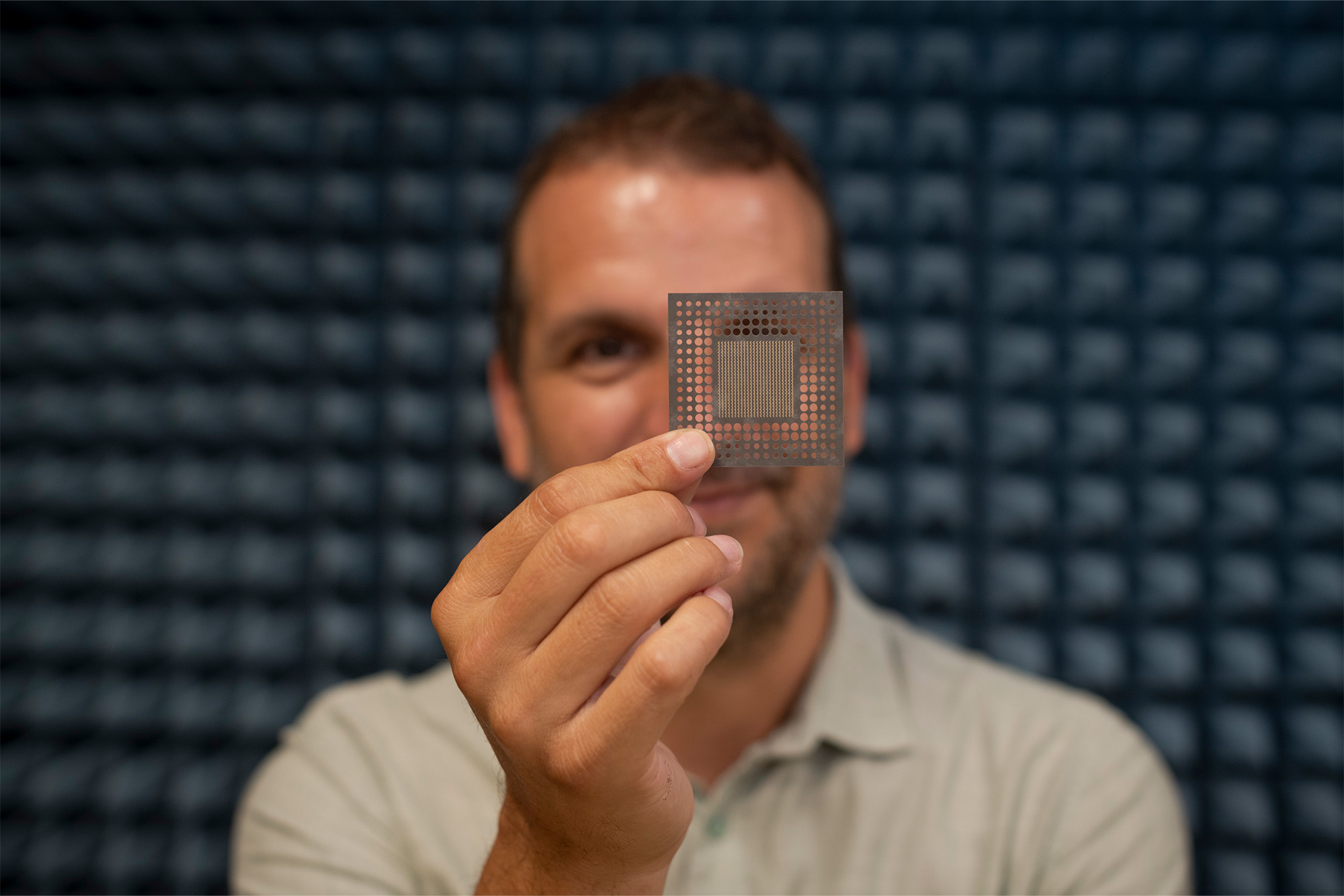
He says that during his PhD, he spent a lot of time on calculations. Because of that, it’s now incredibly rewarding to see so much of his research being applied in Terrameta — a project launched in January 2023 to discover new technologies for 6G. He explains that this allows them to understand what worked, “what didn’t work and what the real constraints are.” He adds: “We’re often obsessed with achieving a small improvement that doesn’t actually matter for the system in practice.”
Terrameta is a project on 6G — what makes it different?
This project aligns with the European Union’s goals to develop new 6G technologies — which is why we’re using European technology and partners. Our focus is on increasing 6G capacity and producing prototypes for smart surfaces.
What use cases have you tested?
Several — but the most widely applied, so to speak, is the one resulting from our partnership with Dell. In that case, we specifically needed greater connectivity between the robots and the base station. Why? Because Dell wants the robots to be autonomous — able to move around the factory floor and identify objects in real time — which means current wireless technologies just don’t work. It can be done with cables, but whenever the factory layout needs to be restructured or altered, that setup no longer works because the cables have to be removed. This is a use case where the capacity of the frequency band we’re working on can make all the difference.
Was this defined from the outset?
Yes — when we put forward the proposal, we already had a few use cases in mind. We ended up focusing on the one we’d developed furthest, and that turned out to be one of the main ones. We managed to carry out demonstrations where Dell’s partner brought the robot with the camera here — at a meeting in Lisbon, there was a simulation in which the robot captured the image, transmitted it and received it. We were able to see it in almost a real-world environment and measure the increase in capacity. We’ve reached this level; we’ve gone from developing the hardware, installing the antennas and setting up the entire chain.
Is that one of the advantages of the project?
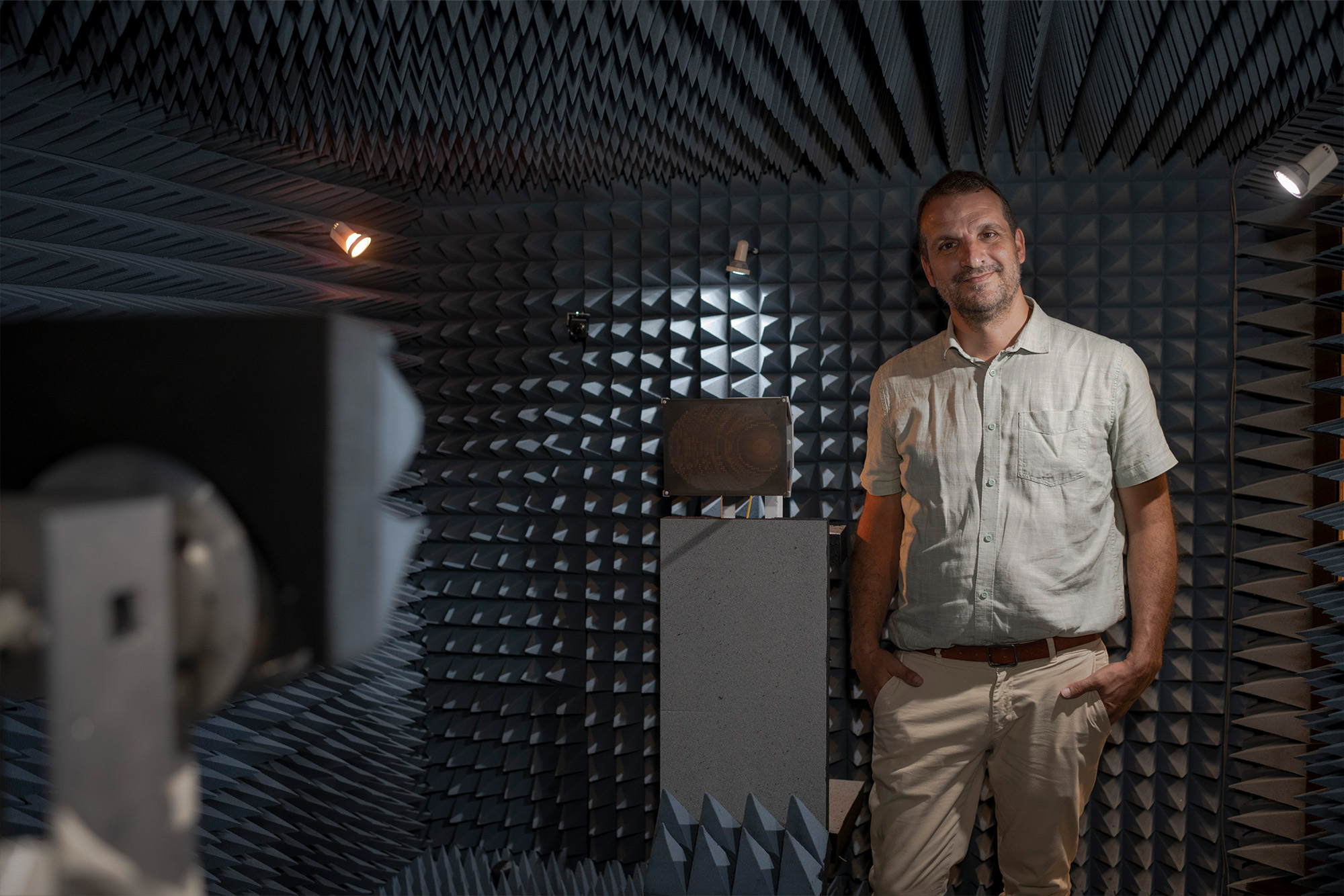
Yes. At the Institute of Telecommunications, I’m responsible for the hardware development side of these smart surfaces. We already had some knowledge of numerical simulation and had also developed some implementations. Now, we’ve brought in other partners and applied further technology, which has enabled us to produce more advanced prototypes. They’re all fully functional, and we’ll be handing them over to the European Commission along with the results.
Once we’ve incorporated intelligence and configurability, there’s a second, higher-level layer that evaluates the outcome of all communications within the environment and seeks to optimise the state of the network. This is the whole concept behind smart environments.
Does Europe need to take a stand and stop playing catch-up when it comes to 6G?
The partnerships developed within this project are not just about individual partners doing their own work. It’s actually a partnership based on collaboration and sharing results. We have prototypes we’ve never seen before, we have the ability to apply our designs to things we wouldn’t normally be able to and we’ve managed to take measurements that we usually can’t. It’s a challenging frequency band.
Why? Because there’s more data?
The trend is this: as you move up the frequency spectrum, you get more capacity, more data, more bits per second to transmit. In applications that require transmitting massive amounts of data in real time — like the scenario I described earlier — this really does make a difference.
More data and faster speeds, is that it?
Yes, that’s the ultimate goal. It’s a slightly different concept from what we’ve seen so far with mobile phones. As we move up the frequency spectrum, we need communication that’s almost like “lightning” — because at these frequencies, the signal attenuates and disappears very quickly. And this makes all the difference from a communication perspective. We need to direct the signal; the antennas need to be smart enough to determine where to send the “beams” and to cancel out any factors that might interfere with that communication.
Is this a new development in research?
This technology wasn’t being developed; there was a gap in this frequency band that we’re trying to fill. And I believe we’ve managed to do so successfully. Once we’ve incorporated intelligence and configurability, there’s a second, higher-level layer where the outcome of all communications in the environment is assessed and attempts are made to optimise the state of the network. The concept of smart environments is precisely about this. Furthermore, we also want everything to run efficiently, with low energy consumption — that is a key concern for us.
Going back to my question from earlier: is Europe still in time to catch the 6G train?
This project is a way for Europe to catch that train. Although, when we talk about trains, there are always lots of them — and some countries have high-speed trains whilst others don’t. [laughter]
Are there any companies interested?
We’ve enjoyed great collaboration with European industry. From an academic perspective, this project is excellent because it allows us to observe its real-world application, while at the same time, companies get to see their equipment integrated into a production line. We also have companies specialising in the design of smart components that see a new application for their product here. One of Terrameta’s industrial partners — ACST, a medium-sized German company — has developed a product that is already part of its portfolio.
What product?
The company sells various components operating at these Terahertz frequencies. They’ve actually managed to develop a new component — you see, one of the main problems with these frequencies is making sure the source generating the signal has enough power. As this signal is very weak, you have to boost the power slightly, which isn’t easy at all in this Terahertz band. For us, it was excellent — it was one of the highlights of the project.
Is this application important for a researcher?
For me, it’s essential. By being able to apply what we’re doing, we can understand what worked, what didn’t, and identify the real constraints. Often, we’re obsessed with achieving a small improvement that doesn’t actually matter for the system in practice. Sometimes, this is the only way we realise that it’s better to reduce consumption slightly, or to prioritise another feature instead… I spent my PhD working in a very insular way, just crunching numbers — so as I progress, I find this approach incredibly enriching. One of the goals of science — aside from creating knowledge — is to drive innovation and make a difference.
From an academic perspective, this project is excellent because it allows us to observe how it’s applied — while at the same time, companies get to see their equipment integrated into a production line.
A question from a five-year-old…
Those are the best questions [laughter].
Is this technique — the so-called Reconfigurable Intelligent Surface — already being used in 5G?
No — and it’s precisely one of the technologies that could enable us to move up the frequency spectrum. But the boundaries are a bit blurry because these surfaces can be placed right next to the antennas, which then makes the antennas themselves reconfigurable. There are solutions, but they’re niche — let’s just say it’s not the most common approach.
More questions from a child: what exactly enables them to carry more data at higher speeds?
It’s actually pretty simple to explain. It all boils down to making sure we have a strong enough signal so it doesn’t get lost in the background noise — because the clearer the signal, the more information it can hold. Think of it like Morse code: if we use a much higher frequency, it’s like being able to tap the messages out way faster. So, the goal is always to push the frequency higher so we can send data faster and pack in more information.
Which is also a major challenge, isn’t it?
That’s right. And we also need a more efficient way of transmitting energy. Right now, mobile
phones have an antenna that radiates signals in almost every direction. There’s no real directional focus, so there’s no need for these surfaces to try to create pathways. However, as soon as we create beams, we run into obstruction problems — for example, an object getting in the way immediately cuts off communication. The solution may involve the antenna rerouting the signal to a smart surface to create a new path. But this has to be done in a matter of microseconds.
Could 6G further change the way we use technology?
It all depends on the applications we end up with. From my point of view, I think we’ll see more and more smart environments. For example, we’ll walk into a room, put on a pair of glasses and be able to interact with everything. So, the applications will tend to become increasingly realistic and immersive.
To what extent can Artificial Intelligence make a difference in projects like this?
It can be used to optimise spaces, decide on the best configuration and perhaps help minimise energy consumption… The advantage is that it identifies patterns — it’s a useful tool whenever there’s a large collection of data.
Are we getting carried away?
It’s best not to go down that road… [laughs].
At this stage, what’s important is that we don’t lose our own capabilities — our autonomy. For our students, Artificial Intelligence is a huge challenge — because the answers come out beautifully structured and, as a result, it’s hard to tell what’s actually logical and what isn’t. I often say that the principle of least effort — or minimal action — is very powerful. When we have a simple way of getting an answer, we memorise that method because it’s the quickest way to do it. For those just starting out, it’s hard to understand the work involved in reading books and so on.
Does science also stem from curiosity and from trying to fight our natural tendency towards inertia?
You learn more from making mistakes than from getting things right.
Where did the name of the project, Terrameta, come from?
Good question… I think “meta” comes from “materials”, because these are surfaces that aren’t really surfaces — they’re engineered, artificial surfaces. “Terra” refers to the earth and, moreover, brings to mind all of the cycles of our planet.
|
Sérgio de Almeida Matos IT Polo Iscte |
Terrameta Aims to develop new 6G technologies, namely through wireless links and the production of intelligent surface prototypes. |