EMPOWERING WOMEN FARMERS
Rita Calvário
by Sara Belo Luís
translation Arisai Vogel
photograph Luísa Ferreira
“WE MUST LEARN TO RESPECT TRADITIONAL FARMING METHODS THAT EXIST IN THESE REGIONS”
The Feed project uses a simple approach — gathering testimonies from women farmers — to achieve an ambitious goal: advocating for a more equitable and sustainable food system.
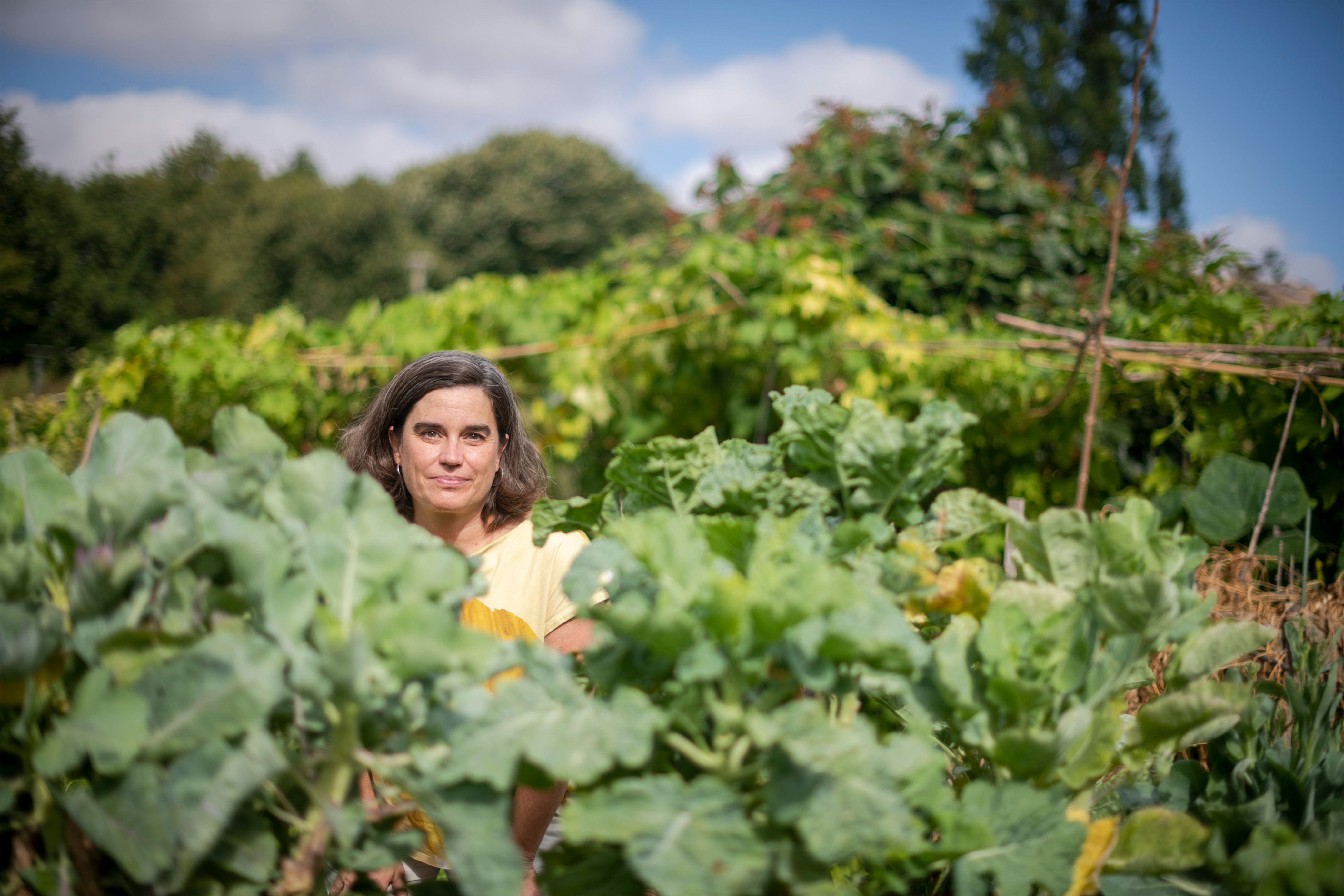
For a year, she gathered testimonies from various women farmers in Portugal, the Basque Country and Galicia. She let them recount their experiences, listened to their stories about a “love for the land” and, in doing so, “gave dignity to their voices” — as she explains in this interview about Feed: Fighting for Food and Gender Justice. The result is a collection of texts and videos that’ll later prove useful for other projects by Rita Calvário, an agronomist who has long been conducting research in rural sociology. “We have a great deal to learn from these women,” she notes.
Feed has gathered testimonies from a group of women working in agriculture. Who are these women?
They’re rural women from areas characterised by small-scale family farming. They fall into two categories: on one hand, they’re food producers involved in agroecology or systems considered innovative from a production perspective. On the other hand, they’re activists — or at least have some involvement with more collective projects, formal or informal networks and farmers’ organisations.
For these women, work isn’t just a duty
— it’s not just a way to earn a living.
It also represents a way of life, a way of being. There’s a a deep connection and a love for the land.
This is a project that grew out of a broader one on gender inequalities in Portuguese agriculture. What’s the significance of this specific research?
That other project has been running for six years and focuses on women agricultural workers — particularly migrants — as well as women working in family farming.
I am interested in understanding the social, economic and political conditions that give rise to gender inequalities, what intersections exist — or don’t exist — and what is specific to each of these groups. I also want to understand these women’s agency: their ability to cope with everyday life, to devise strategies and to negotiate power relations.
How did you come to choose the three regions where the project is being carried out — Portugal, Galicia and the Basque Country?
The focus is on Portugal, but since I’ve been involved with other teams, I’ve drawn on my networks with other researchers. During my PhD, one of the case studies was in the Basque Country, looking at young farmers practising agroecology. In Galicia, there are also researchers working on agrarian history, rural women and gender issues. In this project, participatory action research is a very important methodology.
Did each researcher focus on their own area?
Yes — mostly for proximity and convenience, and also because of the language the interviews were conducted in. In my case, the key criterion was that the women had to be involved in organisations or networks, albeit in very diverse ways. I was also keen to cover a range of regions and not just limit myself to the Alentejo… I spoke to various organisations, including integral cooperatives in the Guarda, Castelo Branco and Odemira areas, an organic farming association in the Algarve… as well as a more traditional farmers’ association in Trás-os-Montes.
Are these women all different from one another?
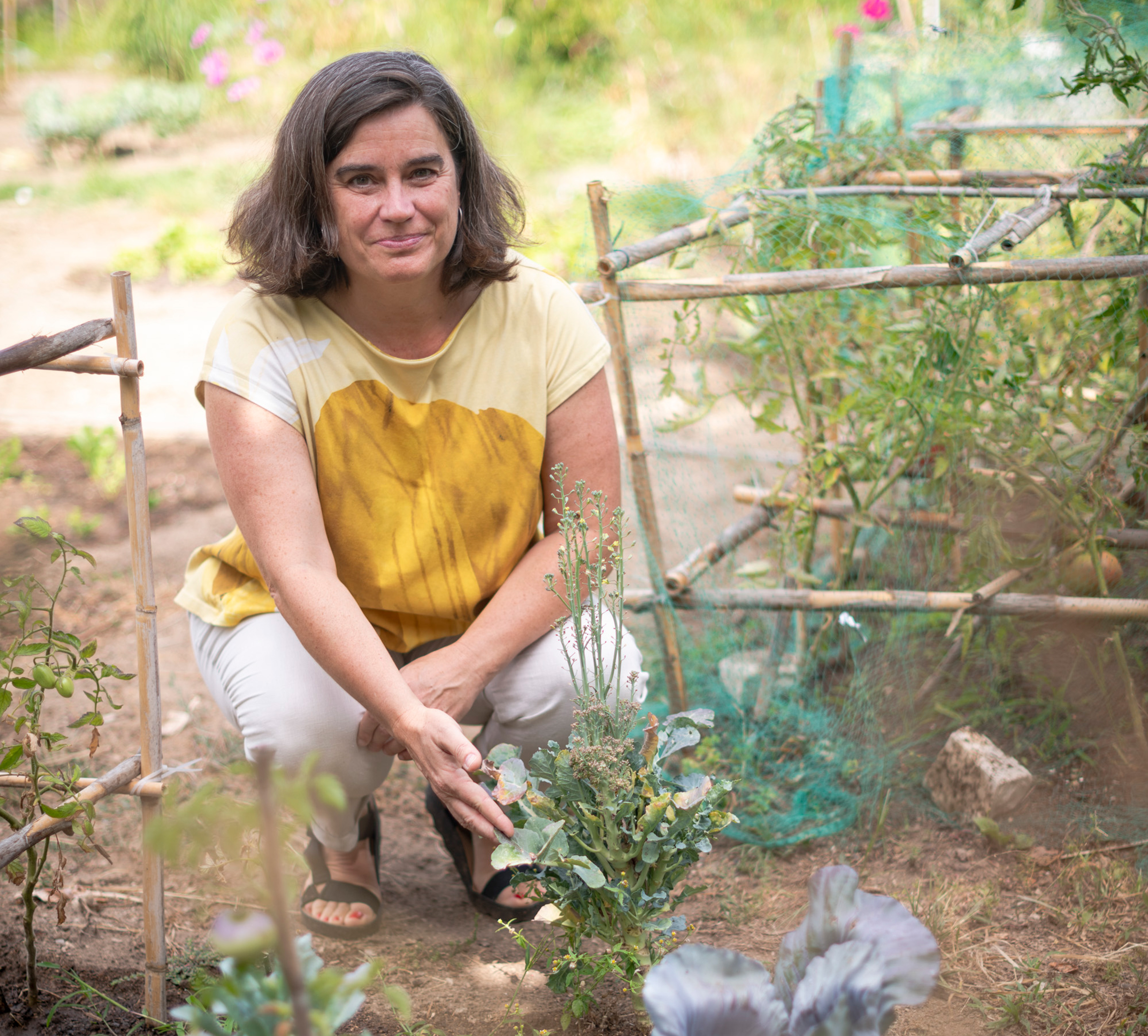
Yes — their stories are incredibly diverse. They vary greatly in terms of age, education and background, for example. Some had no connection whatsoever to the rural world, whilst others had childhood memories of it. One of the ladies is 82 years old, but there are also much younger women…
What, exactly, is agroecology?
There are various definitions. One of them relates to production — so to speak — using production methods that differ from the more conventional ones: they reject external inputs and focus on designing a circular economy system based on existing resources. In my view, however, agroecology is more than this: it’s a social and political movement. Farming is not just about production, and it isn’t separate from the land, rural communities and ecosystems.
It helps that we filmed the interviews and that there is a website where we’ve made these women’s stories available almost in their entirety. There’s no outside researcher’s perspective overlaying them — it truly reflects exactly what they have to say. This helps to give their voices dignity.
And how do labour issues come into play?
Looking at these different dimensions also means looking at labour issues, rights and inequalities — from a perspective of social justice, climate justice and, consequently, the political movement. We must fight for an agri-food model that puts farmers, people and ecosystems at the centre, rather than viewing food merely as a commodity.
Were you surprised whilst gathering these testimonies?
Yes, I was. As I said, these women have very different backgrounds. But there’s one central element, which is the concept of care. Care for the environment, for animals, for people and for the land. These women bring life into the world — they produce food that nourishes the land, people and animals. And that gives them a sense of fulfilment in working the land. For them, work isn’t just an obligation — it isn’t just a way to secure a livelihood. In some way, work has to be rewarding, which means it also represents a way of life, a way of being. There is a deep connection and a love for the land.
Did you ever feel that these women were sceptical of the researchers’ work?
No — not sceptical, no. But in some cases, there’s a certain weariness with academic work because these women don’t always see a return from it. In the case of the Basque Country, where some have a more activist background, it’s not always clear to them whether it’s worth it. It also helps that we filmed the interviews and created a website where we’ve made their stories available almost in their entirety. In other words, there’s no outside researcher’s perspective overlaying them — it truly reflects exactly what they say. This helps to give dignity to their voices.
Does science need to diversify the ways it communicates?
Of course — scientific articles are important. But they are completely different things and I believe we need to diversify how we communicate with society a little, as a way to give back the work carried out in academia.
Portugal and Spain have overlapping histories. Both countries experienced long periods of dictatorship that left a profound impact. And in both countries, agriculture played a huge role in the landscape and society until 50 or 60 years ago.
Does the fact that Feed was developed in Portugal, Galicia and the Basque Country suggest that there’s also a certain notion of Southern Europe at play here?
Ever since I did my PhD, the focus of my work has been on Europe. I always approach it from the perspective of the periphery or semi-periphery — well, though that’s highly debatable…
Because the peripheries themselves have other peripheries.
Exactly. The truth is that Portugal and Spain have intersecting trajectories. They both experienced long periods of dictatorship that left an extremely profound impact. And in both countries, the influence of agriculture on the land and society was also very strong right up until 50 or 60 years ago. It was from the 1960s onwards that, with the massive rural exodus, the modernisation of agriculture began. Joining the European Economic Community in 1986 also brought about very rapid changes in rural areas. Portugal was the country that saw the sharpest decline in the number of farms. And it’s a country where the influence of small-scale family farming and large-scale agriculture is enormous.
Could the project also contribute to the debate on transforming food systems?
Yes — in a number of ways. First and foremost, it can raise the profile of the type of farming these women practise and highlight a different care-based approach. It also draws attention to this perspective on food production: as something that’s sold and consumed, but which also involves sustainable practices that look after the environment, produce nutritious food, and follow rhythms more in line with natural cycles. These business models continue to be undervalued, even though in many cases, they’re also commercially successful...
Would you say we have something to learn from these women?
I believe so — I think we have a great deal to learn from them. First and foremost, we must learn to respect the farming methods that exist in the region, look at the realities on the ground, and understand what people do and why they do it. We cannot start from preconceived notions that there’s a single model that works and should be applied everywhere simply because it’s modern, productive and economical. All of this has led to extremely severe inequalities across regions and, above all, has deeply marginalised women and the farming practices they can provide. If the goal of policy is to create more cohesive, environmentally sustainable regions with greater gender equality, then we really do need to do this. It’s clear that the type of farming that’s been promoted — intensive, large-scale farming — creates a range of very serious problems, no matter how much Artificial Intelligence we apply.
Does this also amount to a rejection of technology?
These women don’t reject technology — they adapt it to suit their needs. These women never stop thinking — and learning. In fact, trial and error are very important for systems operating close to ecological equilibrium.
And does it force us to look at the rural world in a different light?
Yes, I think so. And it challenges a certain notion of backwardness, a certain notion of underdevelopment and what modernity actually is. The urban-industrial model isn’t necessarily progress. Of course, I don’t want to romanticise these practices either. Everything has its place…
The very idea of the abandoned countryside is somewhat romanticised.
And it doesn’t reflect reality either. Because there are many people, both long-established locals and newcomers, who are running their own projects. There are young people who are creating a dynamism in these areas that often goes unnoticed. We also wanted to challenge, to some extent, the idea of the rural world as depopulated and empty…
Finally, how does an agronomist end up in the social sciences?
This stems from a certain prejudice against the social sciences. I am an agronomist, but specialising in rural sociology and agricultural economics. My background also helps me to bridge the gap between natural systems, technology and all the associated economic, social and cultural issues. In fact, there’s a long-standing tradition in Portugal in this field.
|
Rita Calvário Dinâmia’CET-Iscte |
Feed A project based on testimonies from women farmers engaged in agroecology and involved in collectives across several regions of Portugal and Spain (Galicia and the Basque Country). |