MIGRATION AND HOUSING POLICIES
Sandra Mateus
by Sara Belo Luís
translation Arisai Vogel
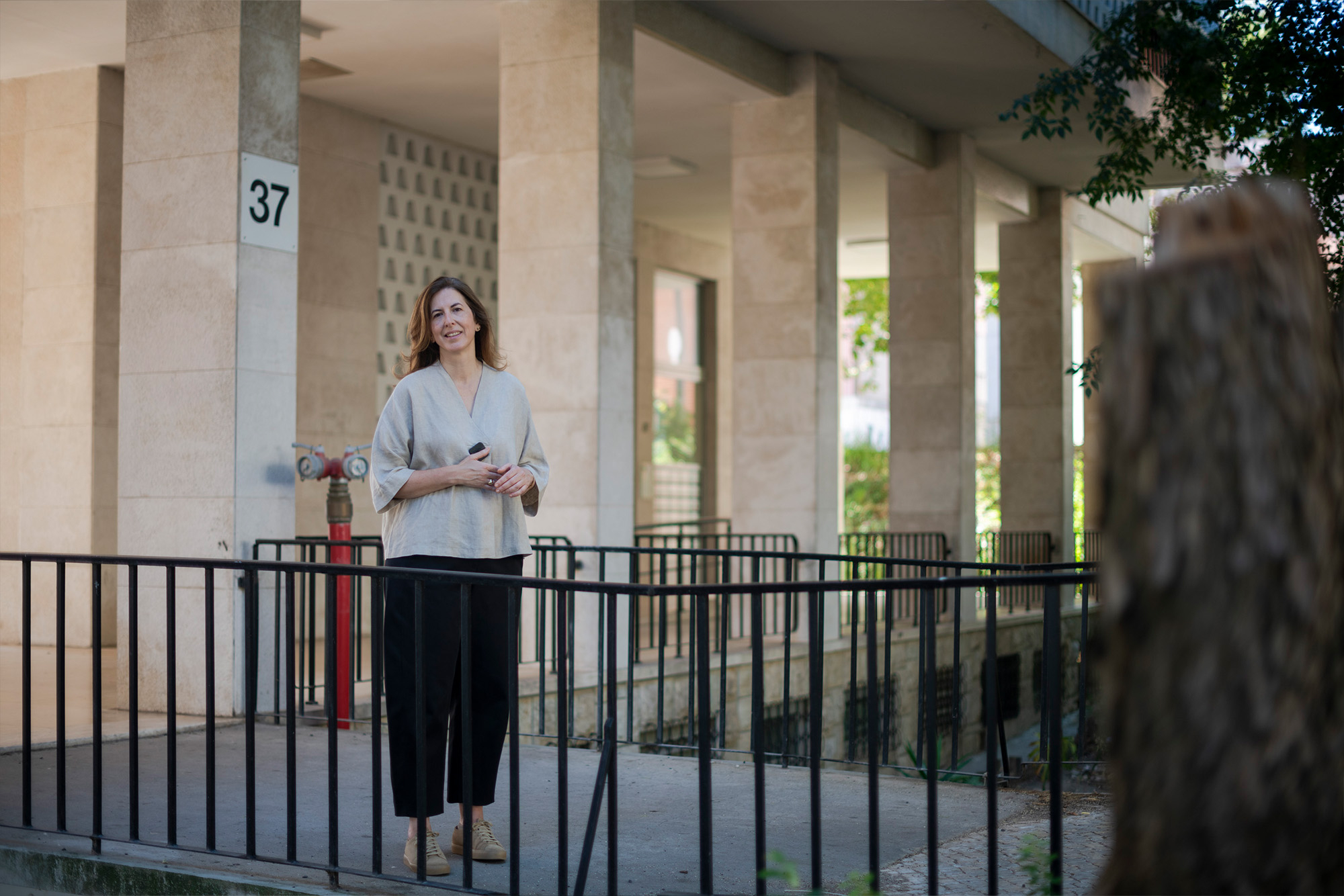
photograph Luísa Ferreira
“THE ACADEMIC WORLD NEEDS TO KEEP ITS FINGER ON THE PULSE OF SOCIETY”
Funded by the European Commission, the H:ouse project’s ultimate aim is to drive a paradigm shift in housing policy. By drawing on “community sponsorship” experiences within migrant communities, we can find solutions to one of Europe’s greatest challenges.

Sandra Mateus is unequivocal: even though projects like H:ouse are not highly regarded in academia, they are fundamental to rethinking the role of universities today. “It is interesting to advance our knowledge by discussing matters amongst peers and engaging in dialogue within our respective fields” says the sociologist. However, she adds, it is in research projects of this nature that “academic work makes the most sense”. Implemented across seven regions in five different countries — Italy, Greece, Slovenia, Hungary and Ireland — H:ouse will come to an end early next year, and it’s hoped it’ll lay the foundations for a change that could influence housing policies across Europe.
Starting with the issue of communication, which might seem peripheral to H:ouse — why has it become so important to the project?
Communication is crucial because one of our main goals is to raise awareness among the most vulnerable groups about their right to housing. We want to mobilise people for action at a local level in the different regions where the projects are being run by organisations trying to build networks. There’s also another dimension relating to the recognition of vulnerability, which is more pronounced among people with a migrant background, asylum seekers and refugees due to the housing crisis and the current political climate.
We want to rally people into action at a local level, across the different territories where projects are being developed by organisations trying to build networks.
I also have some questions here about this political moment…
I’m not sure I can answer them, but… It’s important to note that H:ouse also aims to draw attention to the specific circumstances of these communities within the context of the current housing crisis. These unique situations cannot be ignored, nor will they resolve themselves. Part of the outreach we do is also aimed at mobilising civic efforts within the communities, recruiting volunteers and engaging organisations that aren’t usually involved in this sort of work…
What do you mean by that? Could you give an example?
Social responsibility is more prominent in issues related to equality and disability, for example. As far as migrant populations are concerned, the private sector doesn’t feel as responsible for participating in efforts towards integration and social cohesion. These populations face a double disadvantage in accessing housing due to bureaucratic constraints related to language, low wages, and the European frameworks themselves…
What stage are you at in this regard?
Above all, this is a project that generates networks, thought and knowledge, empowers people and brings together resources, goodwill, vision and experience… And, so far, the private operators involved in housing have been the hardest to attract. We’re securing partners who, for example, provide training on market rules, housing-related terminology and tenancy legislation, but it’s not quite the same thing.
And what are the expectations by the end of the project next year?
By the end of the project, these networks should grow and become more established. In fact, they’ve already expanded considerably… Looking at the latest report, we noticed that partners didn’t just strengthen their ties with existing networks — like local authorities, parish councils, municipalities and committees in social services, health and education — they also managed to bring in new partners from the migrant communities themselves.
Do these networks within the communities operate mostly informally?
Even if it’s informal, we knew they were on the front line. During the first part of the project, we realised that there is a set of mechanisms that opens up more opportunities — things like word of mouth, welcoming people and networking. And the communities do this without any support from social institutions or NGOs, in an informal way that’s barely documented in the literature. So, if we can bring them into the networks we’re creating, we empower ourselves, strengthen our capacity and turn these networks into spaces with multiple voices, which is fascinating. Listening to someone from a foundation or a neighbourhood association is very different from hearing a person with a migration background speaking in the firsthand.
There really has to be coordination with the State. We know that work is most meaningful at a local, municipal and community level, but we can’t leave citizens to manage this on their own either.
Are there differences and similarities between the various countries where the project is taking place?
There are plenty, yes. In some countries, the political climate was — and still is, though it might improve a little now — particularly tense, like in Hungary. Our partner in Budapest is an organisation dedicated to inclusion through the arts. They didn’t use to operate in the housing sector, but through this project, they’ve been able to connect with local groups, including some linked to opposition parties in certain cases. In Hungary, these issues are completely invisible, and our partners even face some persecution. In Italy, we have medium-sized cities with very strong communities and a third sector that’s used to working in partnership. In Ravenna, for example, we’ve seen the creation of a manifesto against racism in housing. In Padua, we also have motivated partners linked to religious institutions.
This project is walking on thin ice by combining two of the most challenging issues in Europe today: housing and migration…
…Thin ice is a good metaphor.
Were you aware from the outset that you’d be tackling such sensitive issues?
We were, but perhaps that awareness wasn’t completely shared among all our partners. Even back then, in Portugal, we had a keener sense of the issue, whereas our Hungarian and Slovenian partners were further removed from that housing shortage, for example.
Is the impact of migration greater in Mediterranean countries?
Yes, but the solidarity networks are also stronger. Part of our work has been to remind these pre-existing networks to keep their focus on housing. We can’t forget or isolate housing from all other areas of integration — they feed into one another. When we think about more innovative solutions, such as co-housing or collaborative housing, the dignity of this involvement is completely different if the person is understood in their entirety, rather than just through the lens of their vulnerability.
Has anything surprised you?
Well, we’re still waiting for more surprises to emerge… But perhaps the first surprise was the near absence of migrant organisations in these initial project networks. We immediately invited our partners to seek out diaspora organisations in their own regions, and to sit down with them to talk.
Is that, shall we say, the ultimate aim of this project?
For me, personally, I think that’s the ultimate aim. The project is funded by the European Commission and is very much geared towards promoting the idea of community sponsorship. The first thing we did as academics, particularly at Iscte, was to highlight that community sponsorship only makes sense in a European context if it’s linked to public support. Of course we need to empower communities, and of course we have to create ever-broader roundtable discussions involving a huge diversity of stakeholders. No one is excluded — universities, landlords, estate agents, the migrants themselves…
H:ouse also aims to draw attention to the specific circumstances of these communities in the current housing crisis.
Are some people easier to engage than others?
Of course they are. And bringing all these people together means preparing materials in various languages, giving people time to get to know each another and listening to one another with respect and trust… It also means we can’t implement top-down solutions.
How did you come to the conclusion that these tools only work when linked to public policies?
Through previous experiences, like what happened in Portugal with refugee support — a civil society initiative launched in 2016 with extraordinary momentum that mobilised organisations, the private sector and ordinary citizens. That initial momentum was followed by a very powerful hands-on experience which also made it clear that communities of well-meaning citizens have their own expectations regarding integration. But goodwill isn’t always enough from a technical perspective, and people often lack the time required for a proper integration process. There really must be coordination with the State. We know that work is most meaningful at a local, municipal and community level, but we can’t leave citizens to manage this on their own either…
For an academic, is a project with this kind of on-the-ground implementation a challenge?
A huge challenge. But that’s where I think academic work makes the most sense. I’d like to be clear on this: it’s very interesting to advance our knowledge by talking among peers and engaging in dialogue within our own circles, tucked away from the actual social experience. What we’re doing, however, is a different kind of movement.
Why is that — because the hierarchy between the parties is reversed?
Exactly, we’re here to serve the project. Of course, when things go well, our partners understand the purpose of our involvement, the data improves in quality and we’re also able to disseminate it. We’re making an effort to do that, and we hope to publish soon.
Have you ever felt that academics are seen as a “nuisance”?
Sometimes, yes, but I also want to believe that what we give back to this forum makes our partners feel part of a wider whole. And that also eases local pressures. We can’t approach these places with an air of superiority, but rather with a great deal of openness to understand the contexts they’re operating in and see how we can contribute to that work. What we’re doing also lends credibility to the institutions themselves — this isn’t a detached, external evaluation, but an internal, reflective and critical evaluation mechanism.
And, on the other hand, are there also those who look at you and feel that this work could be mistaken for a form of activism?
In the case of Iscte, since we don’t exactly have a dedicated team, that question doesn’t really arise… There are other academic teams more firmly rooted there. We’re not serving a cause; we’re serving a project. The fact that we’re an interdisciplinary group internally also helps a great deal. So I wouldn’t call it activism, although I do think that this sort of project — despite not being highly regarded in academic circles — is incredibly valuable in helping academia reflect on itself and connect with the pulse of society.

|
Sandra Mateus |
H:ouse By exploring successful “community sponsorship” initiatives, the project aims to shape effective European housing policies while building a robust support network for migrant communities. |