EFFECTS OF THE ENERGY TRANSITION
Ruy Blanes
by Rita Alves
translation Arisai Vogel
photograph Luísa Ferreira
“THE ENERGY TRANSITION IS ALSO ABOUT COMMUNITIES”
Who pays the price for the energy transition? Who stands to gain, and who stands to lose? And what agency do frontline communities have? The Energeo project investigated six nations across the Global North and Global South.
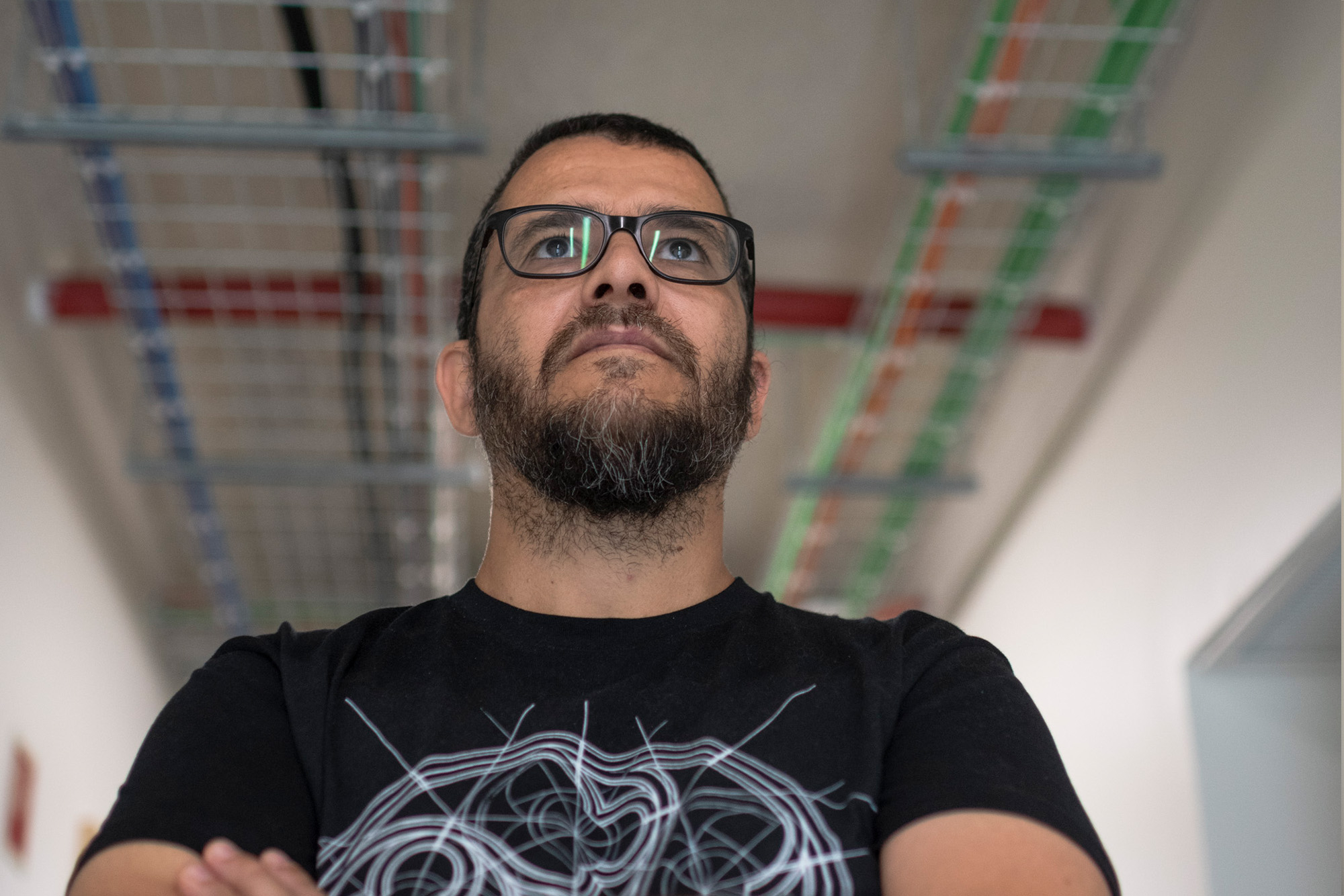
Some areas may be sacrificed in the name of the collective interest. These are known as “sacrifice zones” — places where entire communities must either transform or disappear to make way for the energy transition. Driven by this concept and a long-standing interest in the social impacts of climate change, Ruy Blanes, a researcher at CRIA (Centre for Research in Anthropology), is coordinating the Energeo project to understand who decides what is sacrificed and who pays the price.
How did an anthropologist with a long history of research in Angola come to focus on the energy transition?
My connection with Angola goes back decades, focusing on themes like religion and memory, as well as mobility studies, long before energy became part of my work. However, a major humanitarian crisis in 2009 and its socio-political aftermath sparked my interest in climate issues.
Beyond Angola, your career has also taken you to Europe. How has that international experience shaped your perspective on energy issues?
Through my research in Sweden, Norway, Spain and Portugal, I have come to understand how different national contexts approach the energy transition. Each country has its own history of development and its own relationship with natural resources. What interested me was understanding how these historical and political trajectories shape the way each society navigates the transition.
Portugal boasts a strong narrative of a successful transition, backed by data showing that a large share of its energy production already comes from renewables.
There is a lot of talk about green energy and climate targets. In a nutshell, what was the Energeo project seeking to understand?
What we set out to do was to put ourselves in the shoes of the people living in the regions where the 2050 renewable energy targets are meant to be met. There is a clear disconnect between high-level political targets and the reality on the ground. The project sought to understand this negotiation and the discrepancy between global policy and local life. Ultimately, global targets often vanish on the ground, leaving people with a completely different reality.
Could you give us a specific example of this?
I visited a village within an energy transition zone in Cabo Delgado, where a renewable energy company had set up infrastructure. Instead, their farming land was altered, and the few jobs that did arise were precarious and temporary. Many of these jobs vanished during the pandemic, and people were never called back to work. What struck me was the stark gap between intentions and reality. Young people, in particular, felt completely disconnected from the project. They saw a horizon of opportunities promised by official rhetoric, but in practice, they were constantly barred from accessing this new economy.
What impact did this disconnect have on young people?
This sense of exclusion is, in fact, one of the key factors used to explain the link between the region and the armed insurgency that took hold there. It shows that the energy transition is not just about technology or climate targets; it is about the people and communities who have to live with these changes.
One of the project’s fieldwork meetings took place in the Strait of Gibraltar. What significance has this area acquired in the energy transition?
Straits can be thought of not just as passages, but as points of connection. Throughout history, the Strait of Gibraltar has been the focus of various connection projects, with the most recent ones involving energy transmission, communication cables and natural gas pipelines. Today, it represents the physical separation between Europe and Africa. However, from a geo-energy perspective, it is increasingly seen as a vital link, with energy flows moving between Spain and Morocco, and more broadly, between the European Union and North Africa. As we have seen with the Strait of Hormuz, when political conflicts arise, these connections are disrupted, leading to energy and supply crises.
Why does it make sense to bring together such distinct regions in a single research project?
We wanted to understand how the energy transition plays out in completely different regions with distinct natural resources such as lithium, graphite and green hydrogen. By drawing these connections between the Global North and Global South, we were able to see that global processes are at work across all these countries. Whether we are looking at Portugal, Italy or Angola, there are common issues regarding how resources are extracted, who benefits and who pays the price.
What do they have in common?
The concept of sacrifice zones. In all these countries, certain territories are viewed as serving a higher national or European interest. This justification allows things to happen there that would be completely unacceptable elsewhere. As a result, some communities are forced to either disappear or undergo radical transformation. This logic of sacrifice runs through every single context we have studied.
The project introduces the concept of energo-geographies. What exactly does this mean?
Energo-geographies is an operational concept designed to build on the idea that energy is not merely a technical or political issue, but also a profoundly geographical and social one. Ultimately, it is about understanding that energy is always localised and territorialised.
For those living in Africa, the global energy transition often means more exploitation, more environmental degradation and a further loss of autonomy over their own resources.
And do the views expressed by local communities reach the places where decisions are made?
Yes, there have been several occasions when we have managed to document objections. However, the real question is whether those voices were actually heard in the decision-making forums. Often, communities protest, but the decisions have already been made. The challenge is to work out how to create spaces where these voices have real power to bring about change.
Portugal presents itself as a model for a successful energy transition. Do you agree with this narrative?
Portugal boasts a strong narrative of a successful transition, backed by data showing that a large share of its energy production already comes from renewable resources, meeting its commitments to decarbonisation and diversification.
And when you look at the reality on the ground, does that narrative stand up to scientific scrutiny?
These figures are only partly accurate. The problem lies in how environmental impact is accounted for: while renewable energy sources show positive data for carbon reduction, behind the scenes there is mining and extractivism with a major environmental footprint. In Sines, for example, industrial and energy restructuring has tangible impacts on employment and on the lives of local communities — making it one of the cases that shows the Portuguese model is far more complex than the official narrative suggests.
There is a concept that runs through research in African contexts: that of climate colonialism. What does this mean, specifically?
Climate colonialism refers to the way in which countries in the Global North continue to benefit from the exploitation of the South’s natural resources, but now under the guise of the energy transition. The rhetoric of green energy and decarbonisation is put forward, but in reality resources continue to be extracted, communities continue to be displaced and those already in power continue to benefit. It is the same old colonial exploitation, just with a green label.
Is Africa the most extreme example of this?
Africa continues to be a supplier of raw materials to the developed world. Lithium, cobalt and copper — all of which are essential for renewable energy technologies — are extracted in Africa at an enormous social and environmental cost. For those living there, the global energy transition often translates into increased exploitation, worsening environmental degradation and a further loss of autonomy over their own resources.
Energy transition, sustainability and ecology are often used as synonyms. Is this confusion innocent?
Today, energy has come to dominate the environmental debate. To talk about the environment is, above all, to talk about energy sustainability. Ecology is an older concept linked to social movements for the protection of nature, ranging from Greenpeace to Fridays for Future. Sustainability is a more recent concept, formalised by the United Nations between the 1970s and 1990s, and closely tied to international development. The very concept of ecology has fallen out of favour, replaced by the notion of the environment and linked to debates on the Anthropocene. However, both concepts have been subject to political co-optation, both by the left and, increasingly, by the far right in rural areas.
The project has ended, but the energy transition has not. What foundations does it leave for the future?
The research shows that the energy transition must be far more equitable and attentive to local realities. It cannot be solely about technology or emissions figures. It must recognise that there are losers in this process who are entitled to compensation and a say in the decision-making process. The project also highlights that research plays a vital role in documenting and exposing injustices. And it raises crucial questions: who is this transition for? Who stands to gain and who stands to lose? These questions must remain at the heart of the political agenda.
|
Ruy Blanes CRIA (polo Iscte) |
Energeo Focusing on the zones sacrificed for the energy transition, the project examines the territories and communities forced to transform or disappear in the name of the collective good. |